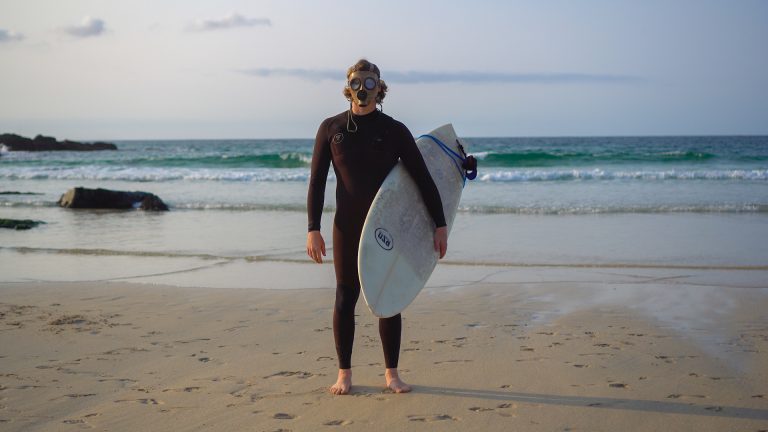
Over 3 million hours of sewage. Thousands of people getting sick. A water system failing to protect our health.
Read the Water Quality Report 2026
Our latest Water Quality Report exposes the scale of sewage pollution across the UK – including in the places where we’re supposed to be able to swim, surf and paddle safely.
In 2025, more than 500,000 sewage discharges poured into UK waters, lasting for more than 3 million hours.
And the human cost is mounting. Between January and August 2026, 1,687 people reported getting sick after using the water, taking a total of 1,923 days off work.
The report brings together sewage discharge data, bathing water pollution and sickness reports to reveal what is happening in our waters – and where the biggest gaps in monitoring and reporting remain.
Read the full report
The sewage numbers are staggering
In 2025, there were:
500,554
sewage discharges across the UK
3 million+
hours of sewage discharges
35,000+
sewage discharges into UK bathing waters
191,000
hours of sewage discharged into bathing waters
That’s sewage entering the places people use for swimming, surfing and other water-based activities. And the problem isn’t confined to one part of the UK.
England
1.8 million hours of sewage in one year
In 2025, English water companies discharged sewage 289,838 times, lasting for more than 1.8 million hours.
That’s an average of around 5,100 hours of sewage discharges every day.
And sewage continues to enter our waters during dry weather. In 2025, there were 14,873 sewage discharges on completely dry days, lasting for 158,395 hours.
In the first six months of 2026, there had already been at least 70,400 hours of sewage discharged on dry days.
The public isn’t always being told quickly enough
Water companies in England are legally required to report sewage discharges within one hour.
Yet in the first half of 2026, more than 50,000 spill events were reported more than one hour after they happened.
The report found that every water company in England failed to meet this reporting timeframe during this period.
Read the England findings
Wales
One sewage discharge every five minutes
In 2025, sewage was discharged into Welsh waters more than 100,000 times.
That’s around 274 discharges every day – or one every five minutes.
Those discharges lasted for a total of 822,265 hours.
And bathing waters are being affected too.
In 2025, 90 Welsh bathing waters were impacted by 4,083 sewage discharges, lasting for 35,669 hours.
The human impact
Since 2019, SAS has received 992 sickness reports from people in Wales, resulting in 2,258 days off work.
In 2025, there were 215 reports. Between January and August 2026, a further 187 reports were received.
Of the sickness reports linked to designated bathing waters, 90% were associated with waters classified as Good or Excellent.
Read the Wales findings
Scotland
How much sewage is really entering Scotland’s waters?
The honest answer is: we don’t know.
In 2025, Scottish Water recorded 100,044 sewage discharges, lasting for 276,759 hours.
But less than a third of the network is monitored.
The available figures cover just 30% of overflows, meaning the true number could be as high as 326,000 discharges lasting more than 900,000 hours, if the monitored overflows are representative of the wider network.
That’s a huge gap in our understanding of what is happening in Scotland’s waters.
Bathing waters are affected too
In 2025, there were 4,627 sewage discharges near Scottish bathing waters, lasting for 4,851 hours.
And between January and June 2026, there were a further 1,136 discharges near bathing waters based on SAS data.
Read the Scotland findings
Northern Ireland
We’re only seeing part of the picture
In 2025, Northern Ireland Water recorded 9,496 sewage discharges, lasting for 35,164 hours.
But only 19% of the network is monitored – just 466 of 2,441 storm overflows.
If the monitored overflows are representative of the wider network, the report estimates that there could have been around 49,700 sewage discharges, lasting approximately 184,000 hours, across Northern Ireland in 2025.
Bathing waters are affected too
In 2025, sewage was discharged into designated Northern Irish bathing waters 1,396 times, lasting for 4,326 hours.
And the human impact is already being reported. In SAS’s 2026 Wild Water Survey, 36% of Northern Ireland residents surveyed said they had become unwell after interacting with the water, with a further 15% saying they may have become unwell.
Read the Northern Ireland findings
This is about more than numbers
Sewage pollution isn’t just a statistic.
People are reporting getting sick after using the water – and taking time away from work, school and everyday life as a result.
Across the UK, 1,568 people submitted sickness reports to SAS in 2025, telling us that they or a loved one had become ill after entering the water. Together, those reports represented 3,146 days off work.
Between January and August 2026, a further 1,687 people reported becoming unwell after using the water, resulting in 1,923 days off work.
Since the beginning of 2025, that adds up to the equivalent of 19.5 years taken off sick.
These reports don’t represent everyone affected by sewage pollution. They are the experiences reported to SAS – and they show the human impact behind the discharge numbers.
What does the report tell us?
The 2026 Water Quality Report highlights three major problems across the UK’s water system:
Sewage is still being discharged at huge scale
More than 3 million hours of sewage discharges were recorded across the UK in 2025, including more than 35,000 discharges into designated bathing waters.
We don’t have the full picture
Monitoring and reporting remain major issues. In England, more than 50,000 discharges were reported late in the first half of 2026. In Scotland and Northern Ireland, only a fraction of the sewage network is monitored.
People are reporting the consequences
Thousands of people have reported becoming unwell after using the water, with many taking time off work as a result.
What needs to change?
The report sets out recommendations for action across each nation.
In England, SAS’s recommendations include reforming how the water industry is owned and run, strengthening legal protection for people using the water, improving enforcement and increasing transparency around sewage pollution.
In Scotland, the report calls for comprehensive sewage monitoring, public reporting and effective enforcement.
In Wales, SAS is calling for a tough, independent regulator with appropriate resourcing and funding.
In Northern Ireland, the report calls for greater transparency about sewage pollution and legally binding targets relating to untreated sewage discharges affecting bathing waters and popular recreational areas.
The challenges differ across the four nations, but the report identifies a common need for better monitoring, greater transparency, stronger enforcement and action to protect public health.
The full picture
The 2026 Water Quality Report brings together the data, investigations and human stories behind sewage pollution across the UK.
From the millions of hours of sewage entering our waters to the people reporting sickness after using them, the evidence shows the scale of the problem – and the gaps that still exist in how pollution is monitored, reported and controlled.
Read the full Water Quality Report
Explore more water quality data
Want to dig deeper into what’s happening in your local waters? Find sewage discharge data, sickness reports and other water quality information from across the UK.
Explore our Data HQ