Tracing the Truth: A Community’s Decade-Long Fight Over Bio-Bead Pollution
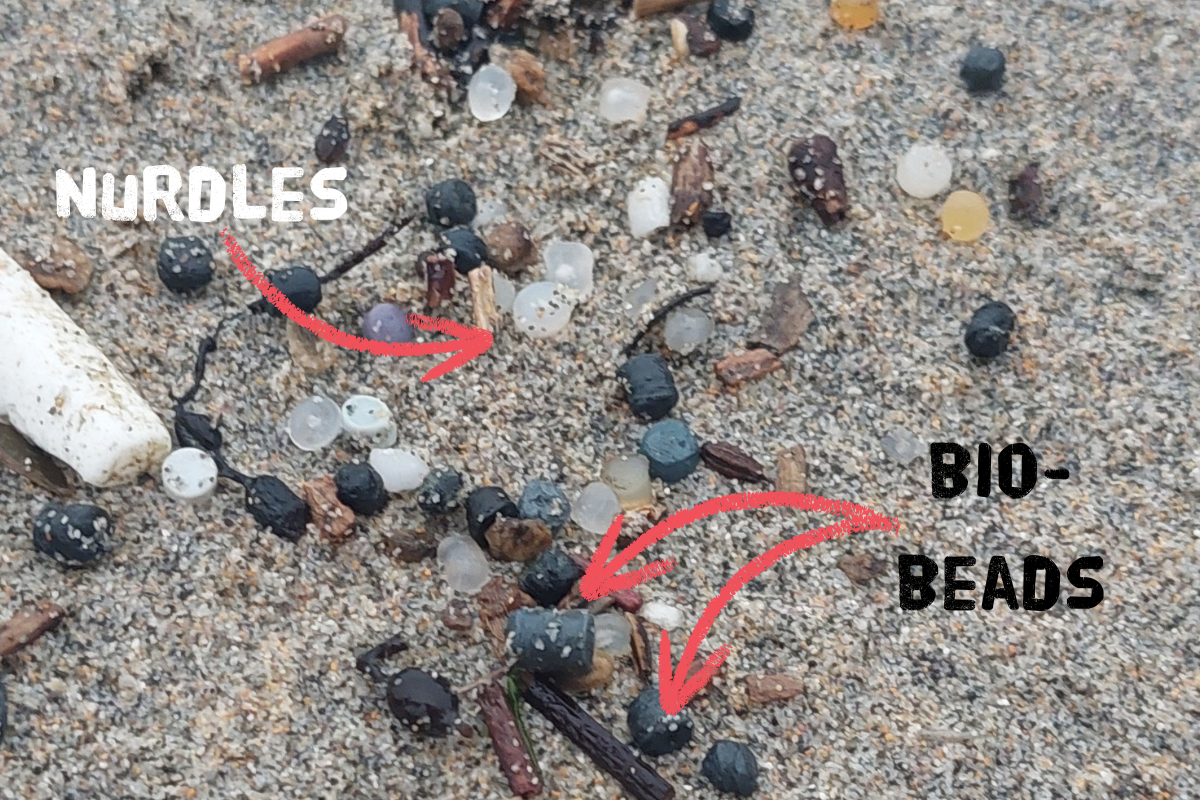
On Dorset’s stunning Jurassic Coast, fossil hunters flock to Charmouth in search of ancient treasures. But alongside the relics of prehistory, plastic pollution washing ashore, are millions of tiny plastic bio-beads. For nearly a decade, the local community has fought tirelessly to uncover the truth behind this pollution and hold those responsible to account.
Sounding the Alarm
In 2017, residents and volunteers began noticing small black and blue beads scattered across Charmouth’s beaches. They were found to be bio-beads, plastic pellets (~3.5mm across) used in wastewater treatment plants to filter sewage. The likely source? South West Water’s (SWW) Uplyme treatment works, just a few miles west and inland, and one of eight SWW sites to use plastic bio-beads to filter wastewater biologically.
Alison Ferris, Earth, Marine and Environmental Interpretation Manager at the Charmouth Heritage Coast Centre, recalls:
“I’ve been carrying out beach cleans since 2015, but around 2017 our attention turned to these beads. We visited SWW at Uplyme in 2017/18 and again in 2019 to find out where they were coming from.”
Building the Case
Alison and a local scientist and nature writer, Philip Strange, together with others in the community worked to raise awareness and gather evidence. A visit to the Uplyme sewage works in 2019 by the community found poor management, with beads strewn across the site. On-site staff told them during the visit that ‘the new containment measures at Uplyme were incomplete, so escape of bio-beads was still possible.’
The small black beads were found to be identical in appearance to those found during other spills in Plymouth, and Newham near Truro by the Cornish Plastic Pollution Coalition, and tests by University of Plymouth showed similar chemical compositions.
So, the community had verbal admission that spills could have been possible, and evidence of similar beads used by SWW at other sites. But did South West Water admit these were coming from their site? You guessed it, no.
South West Water’s Director of Wastewater, Andrew Roantree, went as a far as saying in a Western Morning News Article in 2019 ‘we are confident that there has been no loss of bio-beads from the (Uplyme) site’.
The Charmouth community, including the River Char, and River Lim Action Groups, continued to search for answers. After lockdown, another visit to the Uplyme site in 2022 again found poor storage and beads littering the floor. An article by Philip Strange in 2025, described how, later, a SWW representative admitted failure of containment screens had indeed caused historic spills.
Mounting evidence, and pressure from campaigning by the River Char Action Group and others, finally led South West Water to fund a clean-up with Nurdle in January and again in March 2024. SEVEN years after the alarm was first raised. However, more beads just came in with the next tide.
While they estimated 5 million nurdles and bio beads were collected, the very next high tide just brought in more. – Alison Ferris
Surely, funding a clean-up led to a written admission of leakages from Uplyme and an apology to the community? You guessed it, still no. No official admission, no apology.
New Bead, Same Silence
By 2024, the community started noticing new black beads turning up on Charmouth beach, very similar in appearance to the old ones, but about double the size. The déjà vu felt painful, after 7 years of campaigning, communities were again left to sound the alarm and search for answers.
While the community haven’t yet been able to ascertain where these new beads are coming from, we do know that South West Water has been recycling smaller bio-beads into larger ones – exactly like the new larger beads being found. A cost saving exercise branded as an ‘pioneering partnership’ which avoids upgrading their crumbling systems.
Has SWW given any written admission of fault for these new beads? Drum-roll…..not yet.
Shockingly, the community has told us SWW has never made any official admission of any spills or leakages from its Uplyme site. And, as yet, we are not aware of any historic or current investigations by the Environment Agency.
Where was the Environment Agency during these spills? And why was it left to the community to visit sites and ascertain the source? Nearly a decade on, there is still zero accountability.
Speaking to the Charmouth community, we are inspired by their resilience, their tireless campaigning. It’s time they had answers.
“These bio-bead based systems are inherently dangerous and without careful management will continue to spill bio-beads to pollute our beaches”. Philip Strange
We need YOUR help to uncover the scale of the problem. If you think you have found bio-media on your local beach or waterway 👇
Surfers Against Sewage Plastic Biomedia Survey – Fill out form
Together with your evidence helping to uncover the scale of the problem, we are calling for:
- Water companies to foot the bill for the clean-up operations and ongoing monitoring into the impact of leaks. From profits and not customer bills.
- Complete transparency from water companies when spills happen. An immediate alert from water companies to the public to enable monitoring & clean-up without delay.
- An independent investigation into spills to be conducted, with findings and solutions clearly communicated to the public.
- Better regulation and enforcement around bio-beads / bio-media and use of them in the water industry